
Submitted photo
By Pamela Nolan, Special to The Message
Whenever a rock is placed or is planted in the ground, don’t expect flowers, fruit or grains to sprout from a rock. That’s not how Mother Nature works. However, when Christ Jesus chooses to place a rock, then that rock most certainly will produce abundant fruit. That’s exactly what has happened during the 200 years since the placement of a piece of blessed rock as the cornerstone for today’s St. Francis Xavier Basilica in Vincennes.
On March 30, 1826, God planted a special rock which signaled the beginning of the construction of today’s basilica. Now, about eight generations later, St. Francis Xavier parishioners are celebrating the great effort made by their forefathers and foremothers.
In the May 6, 1826, issue of the “Western Sun and General Advertiser,” a reporter described the cornerstone as being “a square, oriental granite, highly polished on one side, and inscribed under three symbols of the cross.”
The article presents the entire Latin message which translates as follows. “Thou art Peter, and upon this rock I will build by church, and the gates of hell shall not prevail against it.” The next sentence is, “Built in honor of Saint Francis Xavier. Rev. J.L. Champomier, Parish Priest, 30th March, A.D. 1826.”
The article’s writer addressed future parishioners by adding a thought about what was being passed on to them. “That stone resting as it now does, some feet in the earth, will give to posterity a brief memorial of the edifice, and the name of the zealous missionary by whose efforts it will be erected.”
This exceptionally profound event was to be highlighted with participation from an array of local folks who had a vested interest in the day’s once-in-a-lifetime chance to be part of the literal building of one of Christ’s physical churches here on earth.
The church bell rang at about noon. Following some remarks by a dignitary or possibly by a few speakers (the article isn’t clear on that point), an impressive gathering of folks began to form on Second Street between Church and Vigo streets. Included amongst the “multitude” (as the reporter described the group) were young ladies, matrons, married women, nuns, young men, “aged citizens,” visitors, the contractor, the workmen, several choir members and Father Jean L. Champomier. He was surrounded by the committee members who had been appointed by the congregation to superintend and to aid in the building’s construction.
The St. Francis Xavier procession went as far south on Second Street to Nicholas Street and as far north as Perry Street before heading back to the ceremonial site on Church Street. There, Father Champomier oversaw the laying of the cornerstone “according to the ritual of the church, & the multitude dispersed.”
Almost as significant as the laying of the cornerstone are some of the statements made by Father Champomier in his address to the public. Those comments were included in the local newspaper’s March 4, 1826, issue.
That issue was published 26 days prior to the ceremony. The parish priest was inviting local residents (not just Catholics) to attend the forthcoming event. His opening sentences stated that, “All the inhabitants of Indiana and Illinois … must know, that is, on the 30th of the present month, that is, on Thursday in Easter week, the Corner Stone of the Roman Catholic Cathedral of Vincennes will be laid, the ceremony commencing at 10 a.m. The two adjoining States will soon form but one diocess (sic), of which Vincennes, being the most central town, will become the residence of a Prelate (bishop).”
It had been well known for quite some time that Bishop Flaget had desired to have new dioceses created in an effort to relieve him of some of the vast areas contained within his massive diocese. The Bardstown Diocese consisted of the territory from Kentucky to the Great Lakes and, also, from the Alleghenies to the Mississippi River.
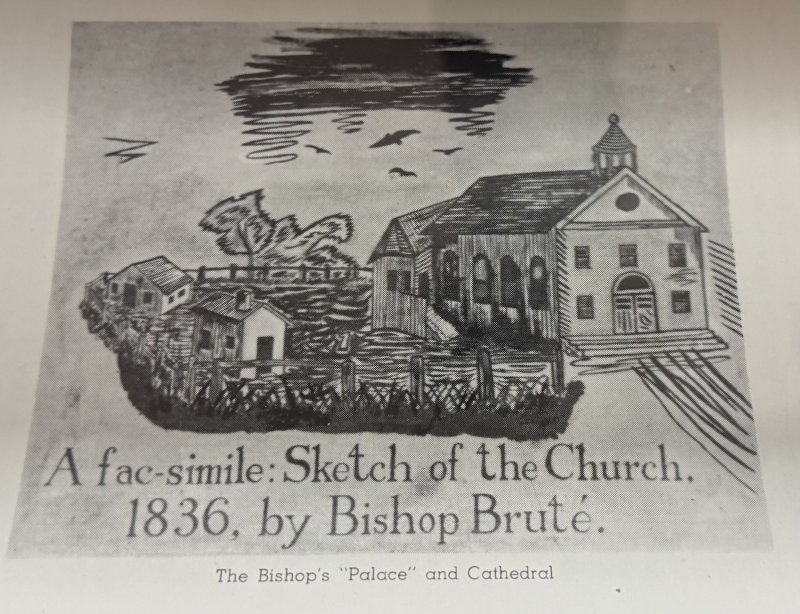
Still, it seemed quite surprising that as early as 1826, Vincennes had already been named as a new diocese with definite territorial boundaries. The Diocese of Vincennes was officially established on May 6, 1834. Therefore, to be burying a cornerstone with the full intent of the structure to be, not a simple church, but to be a cathedral was highly significant.
This new church, rather this brand-new cathedral, immediately elevated St. Francis Xavier’s position and service to the faith onto a higher level. And, even though it’s still not known as to exactly which corner of the present basilica houses the blessed cornerstone, there is one thing for certain. That solitary solid rock upholds one of only 94 minor basilicas throughout the United States. And being a basilica is a much higher honor than being a cathedral.
For today’s 21st century parishioners and visitors to the Basilica of St. Francis Xavier, it is hoped that the magnificence of the interior — which greets all upon entering the former cathedral — that such religious beauty will fulfill the real goal set 200 years ago. And that goal was to build a structure whose interior splendor would cause a person’s “heart, mind and soul to rise to the greater honor and glory of God.”
Pamela Nolan is a parishioner of St. Francis Xavier Parish in Vincennes.